
The 2024 Ford Ranger vs. Toyota Hilux: A Towing Capacity Breakdown
Analyzing torque curves and chassis rigidity under the SAE J2807 standard reveals distinct capability differences between the Ford Ranger and Toyota Hilux for heavy workloads.

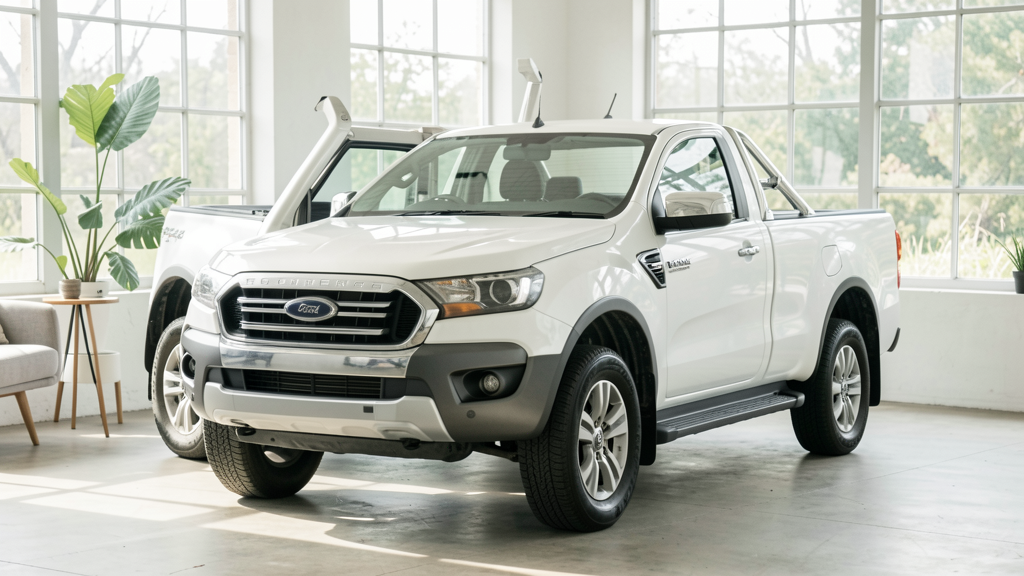
The midsize pickup segment is often defined by badge loyalty rather than engineering reality, but when a trailer approaches the 3,500 kg limit, physics ignores the brand on the grille. For fleet managers and serious operators in 2026, the choice between the 2024 Ford Ranger and the Toyota Hilux hinges on how the respective powertrains manage torque delivery and how the chassis copes with longitudinal stress. While both manufacturers advertise maximum towing capacities that compete closely on paper, the underlying data reveals a divergence in how those ratings are achieved and maintained under the strict SAE J2807 towing standard.
The SAE J2807 Standard: More Than a Brochure Number
SAE J2807 is not merely a suggestion; it is a rigorous series of performance criteria established to standardize towing claims across the industry. Before a truck can claim a specific maximum tow rating, it must survive the Davis Dam grade test—a steep 6% gradient in high ambient temperatures—without overheating the powertrain or suffering thermal degradation of braking components. This standard forces manufacturers to engineer cooling systems and transmission calibration that can sustain load, not just move it from a standstill.
The 2024 Ford Ranger, particularly in the high-specification Wildtrak or Raptor trims equipped with the 3.0L V6 Turbo Diesel, was developed explicitly with these J2807 protocols in mind. Ford’s integration of a transmission oil cooler and a larger radiator capacity relative to the engine output suggests a design philosophy focused on thermal stability under duress. Conversely, while the Toyota Hilux complies with homologation requirements for its advertised 3,500 kg limit (in specific 2.8L D-4D configurations), its engineering lineage prioritizes low-speed durability and heat dissipation in abrasive environments over sustained high-speed highway towing gradients. The difference lies in the "sustained" aspect of the tow; where the Ranger relies on an aggressive cooling strategy to maintain performance, the Hilux relies on a conservative powertrain tune that prevents the system from reaching critical thermal thresholds in the first place.
Torque Curves: The Flatness Factor
Peak torque figures often mislead buyers. A brochure might highlight 600 Nm for the Ranger and 500 Nm for the Hilux, but the area under the curve—when that torque is available—is the critical metric for moving heavy mass.
The Ford Ranger’s 3.0-liter Power Stroke V6 generates its peak 600 Nm at approximately 1,750 RPM, and the curve remains remarkably flat across the rev range. This characteristic is vital when towing at altitude or on highway inclines where the engine operates in a narrow RPM band. The available "lugging" power means the transmission hunts less, reducing wear on the gearbox. This engineering approach mirrors the philosophy seen in other segments where manufacturers prioritize low-end grunt, such as the longitudinal engine layout discussed in Does the 2024 Mazda CX-90 Inline-6 Redefine the Family SUV Segment?.
The Toyota Hilux, utilizing its 2.8-liter four-cylinder turbo-diesel, delivers a robust 500 Nm (or 450 Nm in lower states of tune depending on the market), but the delivery curve is narrower and peaks higher in the rev range, typically around 1,600–2,800 RPM. While the engine is renowned for longevity, the lack of bottom-end cubic capacity means the engine must rev higher or downshift more aggressively to maintain momentum with a maximum load near the limit. In a real-world scenario involving a steep restart on a gravel boat ramp, the Ranger’s V6 torque curve provides a distinct advantage in clutch modulation and initial take-off smoothness, reducing the likelihood of wheel spin or clutch slip.
Chassis Rigidity and Lateral Stability
Towing capacity is useless if the vehicle cannot control the trailer. The chassis acts as the fulcrum for the forces exerted by a heavy load, and here, the platform divergence is stark.
The current generation Ranger (T6.2 platform) utilizes a hydroformed front frame rail construction and features a fully boxed rear frame section. According to Ford’s technical specifications released for the 2023 model year (which carries into the 2024 specification), this increases torsional rigidity significantly over the previous generation. This stiffness is crucial for dampening the "tail wagging the dog" phenomenon. A rigid frame minimizes the deflection of the rear axle relative to the cab, allowing the Trailer Sway Control systems to intervene more effectively with less physical feedback to the driver.
The Hilux employs a high-strength steel ladder frame but has historically retained a design philosophy that favors a degree of frame flex for off-road articulation. While this flexibility aids in keeping all four wheels on uneven terrain without a suspension lift, it becomes a liability when towing heavy loads at highway speeds. The lateral deflection can amplify yaw inputs from the trailer. Furthermore, the Ranger’s rear suspension geometry, specifically the Panhard rod setup on coil-sprung models, locates the axle laterally with greater precision than the Hilux’s leaf-sprung configuration in lower trims. For operators prioritizing 80% highway towing and 20% off-road capability, the Ranger’s chassis tuning offers superior stability. This stability is as aerodynamically critical as the drag coefficients discussed in The Story Behind the BYD Seal's Drag Coefficient of 0.219, as air turbulence behind a high-riding truck can destabilize a tow.
Payload Penalties and The Real Math
A common pitfall in the purchasing decision is ignoring Gross Vehicle Weight Rating (GVWR) in favor of Gross Combined Weight Rating (GCWR). A truck might tow 3,500 kg, but if the truck itself weighs 2,500 kg and has a GVWR of 3,200 kg, the payload allowance for tongue weight, passengers, and cargo shrinks to a mere 700 kg.
Factoring in a standard 10-12% tongue weight for a conventional trailer, a 3,500 kg boat or caravan imposes roughly 400 kg of downward force on the hitch before a single driver enters the cab. The Ford Ranger, specifically in the 3.0L V6 configuration, typically lists a payload capacity hovering around the 900–1,000 kg mark depending on exact specification. This leaves a tighter, but generally usable, margin for gear.
The Toyota Hilux often suffers from a higher payload penalty in its top-tier 4x4 double-cab configurations due to the heavy addition of four-wheel-drive hardware and the robust body-on-frame structure. In some heavily accessorized "Rogue" or "Invincible" trims, payload can drop below 800 kg. When 400 kg is dedicated to the trailer tongue, the remaining capacity for five adults and luggage vanishes quickly. Exceeding this limit places undue stress on the rear leaf springs and shocks, leading to sagging and compromised braking distance. For this reason, the Hilux is often better suited to lighter, faster workloads or tradesmen carrying gear in the bed rather than pure towers.
Verdict: The Workload Decides
Choosing between these two titans requires an honest assessment of the specific load profile.
If the primary use case involves towing at or near the 3,500 kg limit for extended periods on highways or mountain passes, the 2024 Ford Ranger holds the objective advantage. The 3.0L V6 engine’s superior torque curve, combined with a chassis designed explicitly for torsional rigidity and SAE J2807 compliance, makes it the more stable and capable tool for the job. It manages the physics of heavy loads with less driver fatigue and fewer transmission interventions.
However, if the workload involves towing moderate weights (under 2,500 kg) in environments where reliability under duress and lower maintenance costs are paramount—such as agricultural or mining access roads—the Toyota Hilux remains the rational choice. Its engine, while less powerful, is less complex, and the chassis flex that hinders highway towing actually aids traction in low-speed technical terrain.
Ultimately, the Ranger wins on the specification sheet and the physics of leverage, but the Hilux maintains a claim to victory through operational simplicity in rough environments. For the specific question of heavy towing capability based on torque and rigidity, the Ford Ranger is the decisive engineering answer.
The Residual Value Trade-off
There is a final financial layer to this technical debate that extends beyond the towing test track. While the Ranger currently offers superior capability for heavy loads, historical data from 2024 and 2025 indicates that the Toyota Hilux retains a higher percentage of its residual value over a 5-year ownership cycle. Buyers must calculate whether the Ranger's towing superiority offsets the steeper depreciation curve compared to the Hilux. In a commercial fleet context, the lower cost of ownership of the Toyota might justify its slightly lower towing performance, unless the Ranger's capability directly enables revenue generation that the Hilux cannot support.
Sources
To dig deeper and verify the data, see:
Read next
Does the 2024 Mazda CX-90 Inline-6 Redefine the Family SUV Segment?
Mazda's large Inline-6 engine choice for the CX-90 challenges industry downsizing trends by prioritizing torque bandwidth and vehicle balance over peak efficiency metrics.
The Story Behind the BYD Seal's Drag Coefficient of 0.219
An engineering dissection of the BYD Seal reveals how active aerodynamics and surface management strategies translate the 0.219 drag coefficient into tangible range efficiency.